Monthly Archives: December 2011

BOLDLY Go! BOLDLY Speak!

And when they had prayed, the place where they had gathered together was shaken, and they were all filled with the Holy Spirit and began to speak the word of God with boldness (Acts 4:31).

As the Christian church enters the third millennium of mission to all the world I am reminded of the words of my childhood hero, Captain James T. Kirk, who proclaimed the mission of the starship Enterprise: “… to boldly go where no one has gone before.” Jesus declared, “Go therefore… even to the end of the age” (Matthew 28:20). I doubt that His apostles ever considered the possibility that the mission of the church would extend into a third millennium. But here we are, and it seems that many Christians don’t know how to negotiate “the undiscovered country” (another Star Trek reference).

Many Christian leaders are suffering from a crisis of confidence. The first Christian theologians were called apologists. In the second century, to offer an apology for the faith meant to give a sound defense for the faith. Some of the Christian apologists of the third millennium have redefined the word. Instead of saying “We believe,” they cry out “I’m sorry.” As we look back on the past two millenia we should confess our sins; but we should also boldly go into the third millennium confessing the ancient Faith.

Read more »

Encountering God at the Altar

Encountering God at the Altar: The Sacraments in Pentecostal Worship
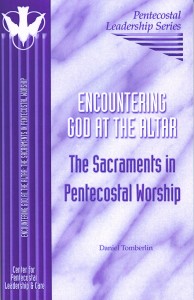
In the 2002-2003 United States Congregational Life Survey administered by the Center for Pentecostal Leadership and Care, Church of God pastors rated “participation in footwashing, baptism, or the Lord’s Supper” as the pastoral task they were least competent to perform. Yet the significant place these formational worship experiences have in Christian life and commitment and in relation to core Pentecostal theological teaching suggests the need for pastoral guidance in their observance. Pentecostal congregations need pastors capable of leading them in meaningful and Spirit-led participation in these biblically based spiritual practices.

This volume in the Center for Pentecostal Leadership and Care Pentecostal Leadership Series is intended to address this need in pastoral ministry. Dan Tomberlin takes seriously the ecclesial (within the church) context of the sacraments of footwashing, baptism, and the Lord’s Supper. He emphasizes the communal nature of their celebration as compared to more individualistic approaches. That is, Tomberlin sees these sacraments as formative and transformative rites of the church rather than mere personal religious experiences. He affirms the reality and importance of the personal dimension of faith but finds the fuller meaning of the sacrament in the relationship between the individual and the community of faith.

Read more »

Wait! Christmas is not Over

“And behold, you will conceive in your womb and bear a son, and you shall name Him Jesus. He will be great and will be called the Son of the Most High; and the Lord God will give Him the throne of His father David; and He will reign over the house of Jacob forever, and His kingdom will have no end”  (Luke 1:31-33 NASB).

Well, it’s Christmas afternoon. First thing this morning the kids rustled you out of bed to play Christmas.  While drinking coffee and eating leftover cookies, the gifts were passed around and everyone celebrated their favorite Christmas tradition – opening presents. Then, while someone was appointed to clean the mess, mom made her way to the kitchen to prepare the Christmas dinner. About noon, a few family guests arrived, and everyone shared Christmas joy and the Christmas meal. Everyone is gone now. The kids are busy playing with their new X-box, and after cleaning the kitchen and dining room you are settled down to watch an afternoon ball game, or take a nap. Christmas is over.

NO! Christmas is not over; it’s just beginning. This is the first day of Christmas. In the Christian tradition there are twelve days of Christmas. During these twelve days we are encouraged to reflect about the rest of the story. Luke tells us that the infant Jesus was presented in the Temple to be circumcised.

Read more »

The Virgin Mary: A Pentecostal Reflection

…the angel Gabriel was sent from God to a city in Galilee called Nazareth, to a virgin… and the virgin’s name was Mary. And coming in, he said to her, “Greetings, favored one! The Lord is with you... Do not be afraid, Mary; for you have found favor with God. And behold, you will conceive in your womb and bear a son, and you shall name Him Jesus. He will be great and will be called the Son of the Most High..and His kingdom will have no end.” Mary said to the angel, “How can this be, since I am a virgin?” The angel answered and said to her, “The Holy Spirit will come upon you, and the power of the Most High will overshadow you; and for that reason the holy Child shall be called the Son of God” (Luke 1:26-35 NASB).

Several years ago (1999), during my first trip to Bulgaria, I visited the Rila Monastery. The monastery is settled in the midst of the beautiful forests near Rila Mountain. I was overwhelmed by the iconic art that covered the buildings. I quickly noticed that the great majority of the art represented the Virgin and Child.

Read more »

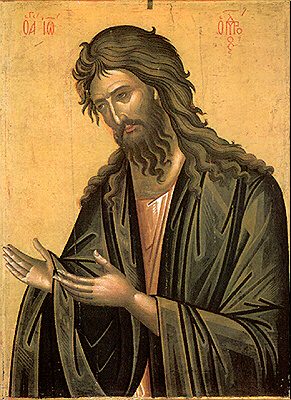
John the Baptist: Witness to Christmas

There came a man sent from God, whose name was John. He came as a witness, to testify about the Light, so that all might believe through him. He was not the Light, but he came to testify about the Light (John 1:6-8 NASB).

We don’t often think of John the Baptist when thinking of Christmas. As far as I know, there are no Christmas hymns dedicated to him, he does not appear in the manger scene, and he does not appear in any Christmas play that I’ve seen. But in the observance of Advent, the person and message of John the Baptist is significant in our preparation for the celebration of Christmas.

John is “a man sent from God.” The last words of the Old Testament prophets were, “Behold, I am going to send you Elijah the prophet before the coming of the great and terrible day of the Lord” (Malachi 4:5 NASB). Malachi preached during the post-exilic period of Israel. It is common to refer to the time between Malachi and Matthew as “the silent years.” While I would not refer to them as the silent years (there was a lot going on!) it is true that for generations there was no prophetic voice. The appearance of John the Baptist stirred the hopeful imagination of the people that their day of deliverance was at hand. The Jewish leaders of Jerusalem send a party to inquire of John, “Are you Elijah… are you the Prophet?” (John 1:21). Although John denied it, Jesus later affirmed that John did come in the spirit of Elijah (Matthew 11:14); John is the forerunner of whom Malachi prophesied. As the “voice of one crying in the wilderness” (John 1:23), John personifies the collective voices of Israel’s prophets from Moses to Malachi. John is the last of the Old Testament prophets.

Read more »

Recovered Treasures

“Or what woman, if she has ten silver coins and loses one coin, does not light a lamp and sweep the house and search carefully until she finds it? When she has found it, she calls together her friends and neighbors, saying, ‘Rejoice with me, for I have found the coin which I had lost!’” (Luke 15:8-9).

Ironic as it may seem, renewal movements often look back for inspiration and guidance as they engage the future. This is especially true for those who seek reformation, or revival, within the Christian church. Renewal movements seek to recover something that has been lost. The Pentecostal Movement was birthed as sincere believers sought to recover the apostolic faith. The heart of Pentecostal spirituality is an encounter with the Holy Trinity.

There are many challenges that face Pentecostal churches as we transition into the second century of the movement. Many of these challenges are not unlike the difficulties of the early church in the second and third centuries; or the challenges of other renewal movements throughout the history of the church. From time to time, the church loses a treasure. The parable of the lost coin teaches us that we must be very careful to guard the treasures with which we have been blessed. The woman had ten coins. Early Pentecostals inherited a rich deposit of Christian tradition.

Read more »

Building Trust in a Skeptical World

Text:  Exodus 20:1-17

Introduction:

Trust is basic to the well being of all human relationships and institutions. Trust is about the proper use of power. When power is properly exercised leaders are deemed to be worthy of trust. A breach of trust occurs when power is abused.

A culture of trust must be built upon the foundation of covenant with God, and the human community.

  • A proper relationship with God is expressed in a proper relationship with others. The building blocks of covenant community are:
  • Honoring parents and elders (Exodus 20:12; 1 Timothy 5:1).
  • Reverence for human life (Exodus 20:13; Matthew 5:21-25).
  • Fidelity to the marriage covenant (Exodus 20:14; Matthew 5:27-32).
  • Respect for the property of others (Exodus 20:15, 17; Ephesians 4:28).
  • Promotion of justice (Exodus 20:16; Matthew 23:23).

Read more »

Remembering St. Nicholas

Have you ever wondered where the traditions associated with the celebration of Christmas began? Some of the traditions regarding Christmas are not found in the Scriptures, but come to us from a long history of the Christian faith. One such tradition is the legend of Santa Claus.

In the year 325 a boy was born in what is now the country of Turkey and he was given the name Nicholas. As a young man he became a Christian and devoted himself to a life in the priest-hood and eventually became the Bishop of Myra in Asia Minor. As the Bishop he became known for his generosity. Once, there was a man with three daughters. He was too poor to give them a dowry so that they could be married. Their future was to become beggars or streetwalkers. When Bishop Nicholas heard about these poor girls, he took a bag of gold coins late one night and went to their house. The girls had washed their stockings and placed them on the window seal to dry. Nicholas dropped the bag of gold coins into one of the stockings and it was found the next morning. He repeated this until each of the girls had a dowry and could be married. Throughout his life Bishop Nicholas gave to the needy.

Read more »

Focused on Mission: Challenges & Possibilities

This was a message I presented to the South Georgia Church of God campmeeting on June 9, 2010. It is presented here in five parts.

Read more »